Black bears, mule deer, whistling marmots, and — if you're lucky — a bighorn sheep on a granite ledge. Sequoia National Park packs more than 320 vertebrate species into a stretch of the Sierra Nevada that climbs from scrubby foothills at 1,370 feet to Mount Whitney's 14,494-foot summit, and the wildlife changes completely along that climb. Knowing which zone you're standing in tells you most of what you'll see.
This guide covers the full cast: the animals you'll almost certainly encounter on a day among the big trees, the predators that stay hidden, the endangered species worth planning around, and the official rules on distances, food storage, and safety. If you're still building your trip, our complete things-to-do guide pairs well with this one.
Sequoia National Park Wildlife at a Glance
Sequoia and adjoining Kings Canyon, managed jointly, host 72 mammal species, more than 200 bird species, 21 reptiles, 14 amphibians, and 11 fish — plus 17 bat species that range from the lowest foothills to above 10,000 feet. Twelve of the parks' vertebrates are endangered, threatened, or reintroduced species, including the Sierra Nevada bighorn sheep and the mountain yellow-legged frog.
The reason for all this variety is elevation. In about 40 road miles on the Generals Highway you climb through oak woodland and chaparral, into cool sequoia forest, and up toward alpine granite — roughly the ecological equivalent of driving from central California to Alaska. Each band carries its own animals, so what you see depends almost entirely on where you are, what season it is, and what time of day you're looking.
One honest expectation to set: most of those 72 mammals are nocturnal and secretive. A handful of species will find you. The rest you'll only see with patience, binoculars, and luck.
Animals by Elevation Zone: Foothills, Montane Forests, and the High Country
The National Park Service organizes the parks' wildlife into three elevation bands, and it's the best mental map you can carry. Match the band to your itinerary and you can predict the animals before you park.
Foothills (below about 5,000 feet)
Hot, dry, and brushy, the foothills along Highway 198 near Ash Mountain belong to gray foxes, bobcats, striped and spotted skunks, and California quail. Acorn woodpeckers hammer at oaks, gopher snakes and California kingsnakes hunt the rocky ground, and western whiptail lizards skitter across the trail. Black bears pass through here too. This is also rattlesnake country, so watch where you step in summer.
Montane forests and meadows (the Giant Forest band)
This is where most visitors spend their day, between roughly 5,000 and 9,000 feet among the sequoias. Douglas squirrels (locally called chickarees), western gray squirrels, and golden-mantled ground squirrels work the groves constantly. Mule deer graze the meadows, black bears tear logs apart for ants, and mountain lions pass through unseen. Birdlife picks up too: western tanagers, violet-green swallows, and pileated woodpeckers. Rubber boas, mountain kingsnakes, and fence lizards round out the reptiles.
Subalpine and alpine (above the treeline)
Reach the high country on a backpacking trip and the cast changes again. Yellow-bellied marmots and pikas live in the rockfields, white-tailed jackrabbits hide among the granite, and Clark's nutcrackers, mountain bluebirds, and gray-crowned rosy finches work the tundra. This is also where the two marquee rarities live: Sierra Nevada bighorn sheep and mountain yellow-legged frogs.
The practical split: a day-tripper driving to the General Sherman Tree covers the montane band and gets deer, squirrels, jays, and a fair shot at a bear. Pikas, marmots, bighorn, and frogs require high-country trails — day hikes like Tokopah Falls get you partway there, overnight trips the rest of the way.
The Animals You're Most Likely to See (Plus the Ones You Probably Won't)
These are the animals that actually appear on most Sequoia visits — no permits, no backpacking, no luck required. They're common because they're diurnal, tolerant of people, and tied to the places everyone already goes.
Mule deer
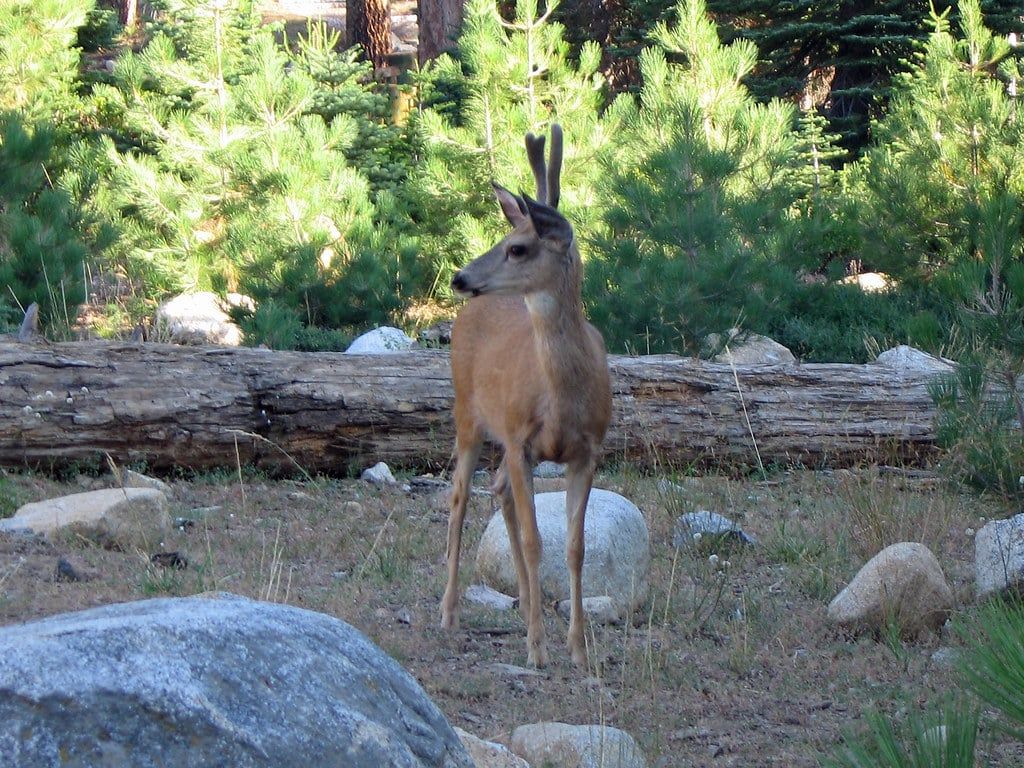
Mule deer are the park's most reliable large mammal, ranging from the foothills to the sequoia groves and named for their outsized, mule-like ears. Does leave fawns hidden alone in vegetation during the day, so a fawn lying quietly by itself is not abandoned — never approach or move one. Look for deer grazing meadows at dawn and dusk.
Squirrels and chipmunks
The chickaree — a small, feisty Douglas squirrel with a chatter that gives it its nickname — is the constant companion of the sequoia groves, scolding hikers from behind every trunk. Golden-mantled ground squirrels work the rock walls around overlooks and picnic areas. They'll beg. Don't feed them; it's illegal and it shortens their lives.
Yellow-bellied marmots
At mid-to-high elevations, marmots sunbathe on boulders in plain view, 15 to 18 inches of russet fur on warm granite. When something worries them they let out a high-pitched whistle that echoes across the talus — you'll hear them on the Tokopah Falls Trail long before you spot one.
The everyday birds
Steller's jays, blue-black and crested, patrol every picnic table in Giant Forest with larceny on their minds. Acorn woodpeckers stash thousands of acorns in granary trees, and common ravens work the parking lots. None of them are shy, which is exactly why they're the birds people remember.
The ones you probably won't see
Here's the reality check: ringtails, spotted skunks, short-tailed weasels, and mountain lions are all here, and almost nobody sees them. They're nocturnal, solitary, and actively avoid people. Count any of those as a genuine bonus, not a plan.
Black Bears: Sequoia's Most Famous Resident
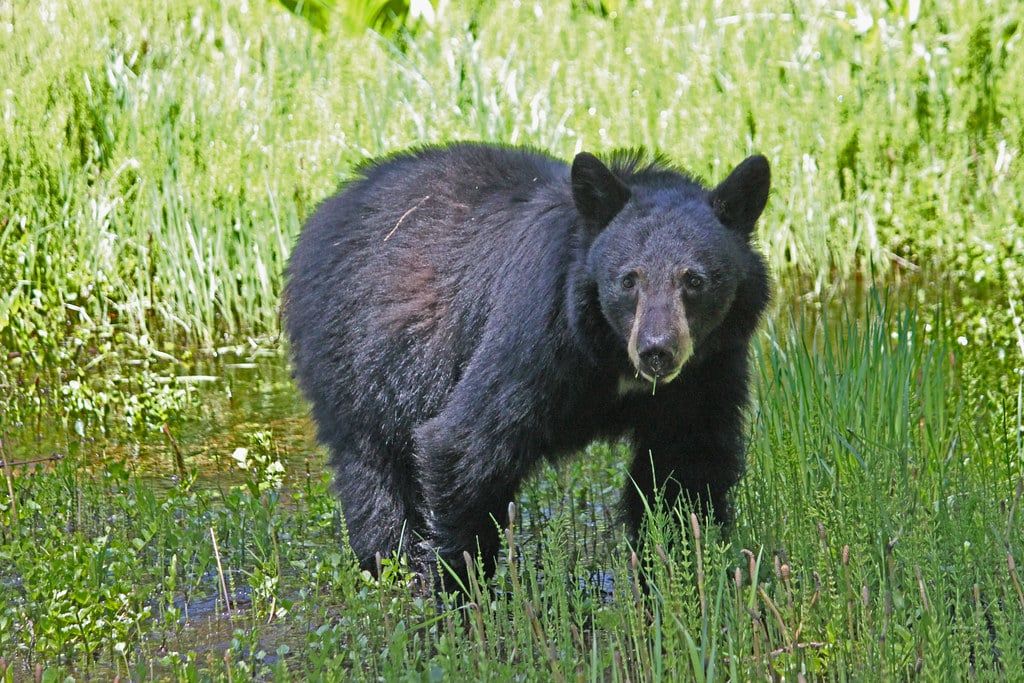
Several hundred American black bears live in Sequoia, and they're the animal visitors ask about most — how to see one, and how not to have a bad encounter with one. Both answers are straightforward.
All bears here are black bears; grizzlies were gone from California long ago. The name undersells the wardrobe: these bears run black, brown, cinnamon, or blonde, and one mother's cubs can be different colors from each other. Adults reach about 350 pounds.
Where the bears are, season by season
Bears follow food, and food moves with the seasons. In spring they dig grasses and rip apart logs for insects in the meadows. In summer they head for manzanita and bitter-cherry bushes as the berries ripen. In fall they climb high into oak trees for acorns. Visitors most often glimpse them around Giant Forest and Crescent Meadow, often flipping logs for ants.
The food rules are not optional
Never feed a bear, keep food within arm's reach when it's out, and store everything scented — food, toiletries, trash — in the bear boxes at trailheads, campsites, and parking areas. Improper storage can earn you a fine, and worse: a bear that learns to get human food usually ends up dead. If a bear does get your food, never try to take it back. Stand tall, wave your arms, make loud noise, and throw small rocks, avoiding its face.
If you meet one on the trail
Stay at least 150 feet away — the length of four school buses — and back off slowly while making yourself look big and talking firmly. Don't run. A bear that changes its behavior because of you is too close, even if you like the photo. Report any food-conditioned bear to a ranger.
Predators and Other Elusive Mammals
Everything in this section shares one trait: it does not want to meet you. Your odds are low but real, and knowing the protocols beforehand is what matters.
Mountain lions
Mountain lions are the rarest sightings in the parks — solitary, extremely shy, with one animal holding a huge territory. California as a whole holds an estimated 4,000 to 6,000 of them, and a lion can leap 40 to 45 feet when it wants to. The risk to you is tiny: only 16 verified attacks on humans have occurred in California since 1890, six of them fatal.
If you do see one, make yourself look big, don't crouch or run, and gather children close. The simplest precautions are habit-based: avoid hiking or running alone at dawn and dusk, the hours lions and their prey are most active.
Bobcats, coyotes, and gray foxes
Bobcats hunt the park's foothills, preferring dense brush — potential habitat along the Marble Falls Trail, a 3.1-mile-one-way climb through shrubland and rocky terrain. Coyotes and gray foxes are also foothill animals, most often seen moving at first and last light. All three will give you a few seconds and then melt into the brush.
Fishers and martens
Deep in the montane forest live two weasel-family carnivores almost nobody sees: the Pacific fisher and the marten. If you do spot either — a dark, low-slung animal bounding through the canopy or across snow — report it. Sightings are rare enough that rangers genuinely want to know.
Rare and Endangered Species: Sequoia's Bucket-List Animals
The rarities below are what make a Sequoia wildlife trip genuinely memorable, but your realistic odds range from "possible with planning" to "one in ten thousand." That's precisely why they're worth knowing about — every one of them is a conservation story you can watch unfold.
Sierra Nevada bighorn sheep
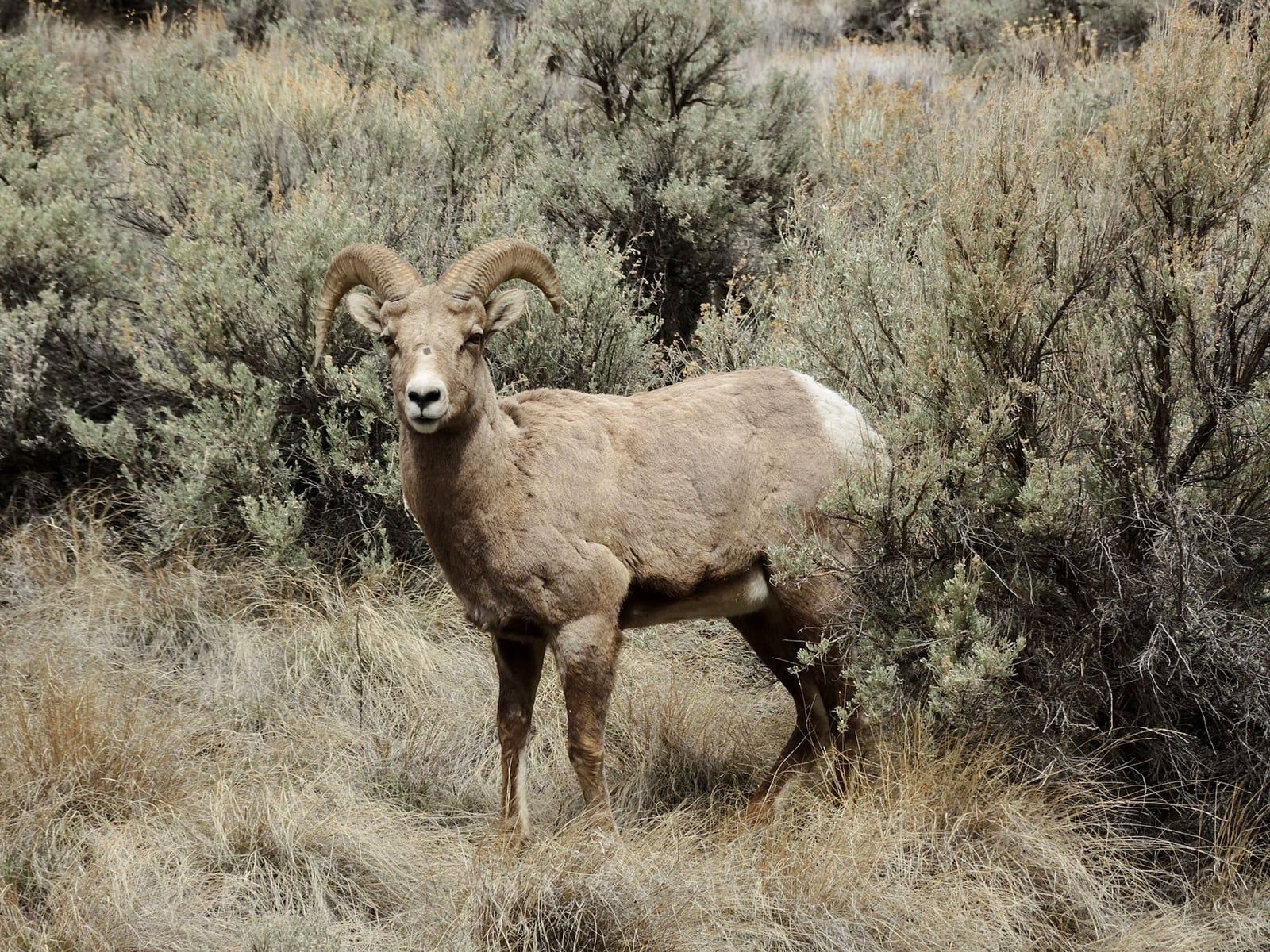
In 2014, agencies flew 10 female and 4 male bighorn by helicopter from Inyo National Forest into Sequoia — the first bighorn in the park in over a century. Roughly 500 now roam the region between Yosemite and Sequoia, with two herds inside the park at Laurel Creek and Big Arroyo. Winter is your window: herds drop to lower, more visible elevations when snow pushes them down.
California condors
With a wingspan up to 9.5 feet, a condor over the canopy is unmistakable. They were confirmed in the park in 2020 for the first time in more than 50 years, and roughly 392 exist in the wild worldwide. None nest in the parks, but they occasionally soar over near Moro Rock and Giant Forest. Scan the sky, but keep your expectations in check.
Mountain yellow-legged frogs
These frogs have vanished from 92% of their historic range, hammered by introduced trout and chytrid fungus. The comeback story is real: after trout were removed from three park lakes, frog populations there grew by roughly 10,000%. Find them around high-country lakes on backpacking routes — sit still at the shoreline and they'll surface.
Sierra Nevada red fox and how to report sightings
The Sierra Nevada red fox, which lives only above 6,000 feet, turned up on a trail camera at the park's edge in 2022 — the first regional detection since the 1930s. If you see a bighorn, condor, marten, or gray fox, pick up a wildlife observation card at any visitor center and report it. Your sighting becomes data.
Birds, Reptiles, Amphibians — and 17 Species of Bats
Mammals get the attention, but the non-mammal cast is bigger — nearly 240 species of birds, reptiles, and amphibians, plus bats almost no visitor ever thinks about.
Birding highlights
Beyond the jays and woodpeckers, sequoia birding rewards binoculars. Western tanagers flash orange and yellow through the montane forest in summer, Clark's nutcrackers work the high-country whitebark pines, and great gray owls hunt montane meadows — they can hear voles moving under snow. The tiny northern pygmy owl hunts by day, so it's seen more often than its size would suggest.
The American dipper
The dipper is North America's only aquatic songbird, and it does something no songbird should: it walks underwater. Watch a rushing stream and you may see a slate-gray bird slip beneath the surface for 5 to 15 seconds at a time, foraging insects off the bottom. Birders report them along streams near the Big Trees Trail from June through August.
Rattlesnakes and the gopher snake lookalike
Of the parks' 21 reptile species — 14 snakes, 6 lizards, and the western pond turtle — only the western rattlesnake is venomous, and it lives mostly in the hot foothills. The gopher snake mimics a rattler convincingly, flattening its head, coiling, and buzzing its tail in dry grass. Check the tail: no rattle, no rattlesnake. Give any snake you can't identify distance either way.
Amphibians and bats
The foothills' California newt and the Pacific treefrog — the classic evening chorus — join the endangered yellow-legged frogs in the parks' 14 amphibian species. Bats are the hidden cast: 17 species live here, from the lowest elevations to above 10,000 feet. Three of them emit calls audible to humans, so at dusk, listen as well as watch for the quick, erratic flight of bats on the wing. The Townsend's big-eared bat, a California Species of Special Concern, is threatened by roost disturbance and white-nose syndrome — one reason cave entry requires permits and decontamination.
Where and When to See Animals in Sequoia
This is the section to screenshot: the places, hours, and months that actually produce animals, consolidated in one place.
Named locations that deliver
A few places consistently produce. Crescent Meadow and Giant Forest: bears, deer, and squirrels. The Tokopah Falls Trail: pikas and marmots in the talus. The Big Trees Trail: American dippers on the stream, June through August. The Marble Falls Trail: bobcat habitat. Moro Rock: scan for condors. All of these except Marble Falls are covered in our guide to the best hikes in Sequoia National Park.
Time of day and the habitat edge
Dawn and dusk outperform midday across every species and season. Animals also concentrate at habitat edges — the line where forest meets meadow is worth standing still and watching for ten minutes. Your car works as a blind, too; wildlife tolerates vehicles far more than it tolerates people on foot.
The seasonal calendar
| Season | What to watch for |
|---|---|
| Spring | Bears digging grasses and logs in meadows; does with hidden fawns; migrating songbirds |
| Summer | Bears on manzanita and bitter-cherry berries; pikas and marmots in the high country; dippers on the streams |
| Fall | Bears high in the oaks eating acorns; the deer rut; quieter trails |
| Winter | Bighorn herds at lower, more visible elevations; solitude in the high country |
Wildlife is one more reason to think about timing: our season-by-season breakdown of the best time to visit Sequoia weighs weather, crowds, and which animals are active. Winter visitors chasing bighorn should also read up on Sequoia in winter, since chains and road closures shape any cold-season trip.
Watching Wildlife Responsibly: Distances, Food, and Etiquette
The distance rules are simple and exact: stay at least 75 feet — two school buses — from any wild animal, and at least 150 feet — four school buses — from bears and other dangerous animals. The test that overrides both numbers: if your presence causes an animal to move or react, you're too close, whatever the tape measure says.
Food rules carry the force of law. Feeding any wildlife is prohibited, as is leaving food unattended or improperly stored, and scented items belong in bear lockers or canisters. Habituated bears get killed — that's the blunt arithmetic behind every food-storage citation.
Pets are not allowed on park trails, only in campgrounds, parking lots, and paved areas on a leash of six feet or less. That rule protects dogs as much as wildlife: wild animals carry diseases that can be fatal to pets, and even deer have attacked dogs. On the disease front, avoid rodent burrows and droppings — hantavirus and plague both circulate via rodents and their fleas in the Sierra.
Two rules people break without thinking: calling, clicking, or whistling to make an animal look at your camera is illegal, and when you spot wildlife from the road, pull fully into a designated turnout rather than stopping in the travel lane. For trip logistics beyond wildlife — entry fees, hours, and getting there — see our guides to park hours and fees and directions to Sequoia.
Frequently asked questions
Are there bears in Sequoia National Park?
Yes — several hundred American black bears live in the park, and they're the only bear species here. Despite the name, they can be black, brown, cinnamon, or blonde, and adults weigh up to about 350 pounds. Storing all food and scented items in bear boxes is mandatory.
What animals are you most likely to see in Sequoia?
Mule deer, Douglas squirrels and golden-mantled ground squirrels, Steller's jays, and yellow-bellied marmots at higher elevations. Most of the park's 72 mammal species are nocturnal and secretive, so dawn and dusk near meadows and forest edges give you the best odds.
Are there rattlesnakes in Sequoia National Park?
Yes. The western rattlesnake is the park's only venomous reptile and lives mostly in the low, hot foothills. The harmless gopher snake mimics a rattler's coil and tail-buzz — but check the tail: no rattle means no rattlesnake. Give any unidentified snake plenty of room.
Are there grizzly bears or mountain lions in Sequoia?
No grizzlies — only black bears. Mountain lions live here but are among the rarest sightings in the park. An estimated 4,000–6,000 live in California, with only 16 verified attacks on humans statewide since 1890. If you see one, look big, don't run, and keep children close.
What endangered animals live in Sequoia National Park?
Sierra Nevada bighorn sheep, reintroduced in 2014 and now roughly 500 in the region; endangered mountain yellow-legged frogs; and the Sierra Nevada red fox, first detected here since the 1930s in 2022. About 392 California condors survive in the wild worldwide, and they occasionally fly over the park.
When is the best time to see wildlife in Sequoia?
Dawn and dusk, year-round. Season shapes the cast: bears feed in meadows in spring, on berries in summer, and on oak acorns in fall, while bighorn sheep drop to lower, more visible elevations in winter.
How close can you get to wildlife in Sequoia?
Stay at least 75 feet (two school buses) from all wildlife and 150 feet (four school buses) from bears. If an animal reacts to you, you're too close. Feeding wildlife and calling or clicking to attract animals are both illegal.
Can I bring my dog to see wildlife in Sequoia?
Pets are not permitted on park trails — only in campgrounds, parking lots, and paved areas on a leash. Wild animals carry diseases that can be fatal to dogs, and even deer have attacked pets, so the rule protects your dog as much as the wildlife.